

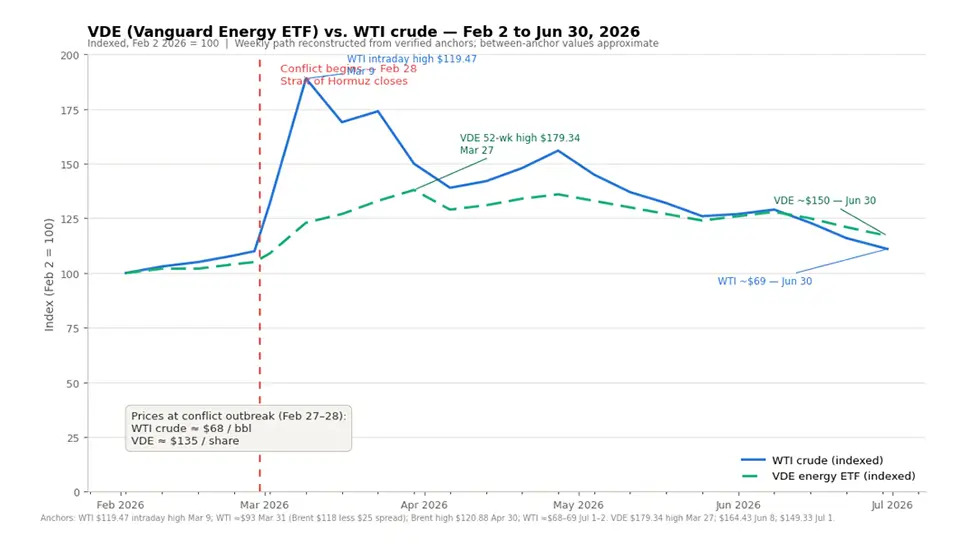
On paper: Investing in US oil and gas producers should have been a home run investment during the US-Iran conflict. Instead, it has been a total disappointment.
Rationally, this makes no sense. Quite literally, roughly 20% of the global oil production went offline for roughly 3 months due to the blockage of the Straits of Hormuz. Oil prices should have been closer to $200 per barrel, and prices should still be high, given the sporadic traffic even today through the Strait of Hormuz and the need to refill globally depleted reserves.
Instead, both oil itself and oil and energy producers have experienced only a modest uptick, leaving investors disappointed.
We Believe This Underwhelming Investment Stems from Three Factors
From an investment perspective, this is VERY puzzling – and has significant implications for investing in oil and gas. Ultimately, we believe this underwhelming investment stems from three factors:
Untapped Capacity
First, and most importantly, we likely are in a cycle of overproduction. Technically, per OPEC, globally, we had roughly 4% of capacity unused. However, this does not capture idle capacity, voluntary product cuts, and untapped capacity via maximizing production. Combined, perhaps could account for 6% or more production.
On top of this, capacity was unlocked due to regulatory relief. Venezuela experienced a broad relief of sanctions prior to the start. Venezuela accounts for roughly 1% of the global capacity. Additionally, there was temporary relief for Russia, which accounts for roughly 9% of the global capacity. Combined, this translates into 10% of the global capacity, although there is a bit of reshuffling of lawn chairs in this analysis since both countries were selling beforehand, but just to a handful of countries like India and China, and they were not operating at full capacity. As a simplistic assumption, we can assume this probably added about 2% additional capacity.
Strategic Reserves
Countries also tapped their oil reserves. It is estimated that 426M barrels were released from countries’ strategic reserves, not counting India and China. This translates into roughly 3% more capacity. India has negligible reserves, but China has massive reserves (1.2B barrels, more than 2x the US). China has never disclosed how much of its reserves it tapped, but it’s plausible that they released 400M-500M barrels, or another 3%. Combined, this translates into 6% additional capacity.
Blockade Workarounds
Finally, even though there was a blockade in place, there were multiple workarounds. Oil was diverted via pipelines. Convoys of trucks drove the oil to safe ports. These workaround strategies translated to roughly 6% of capacity. The blockade was not perfect, and ships did regularly bypass the blockade, although we will never get exact numbers. For now, we will assume that was negligible, but this could be an erroneous assumption.
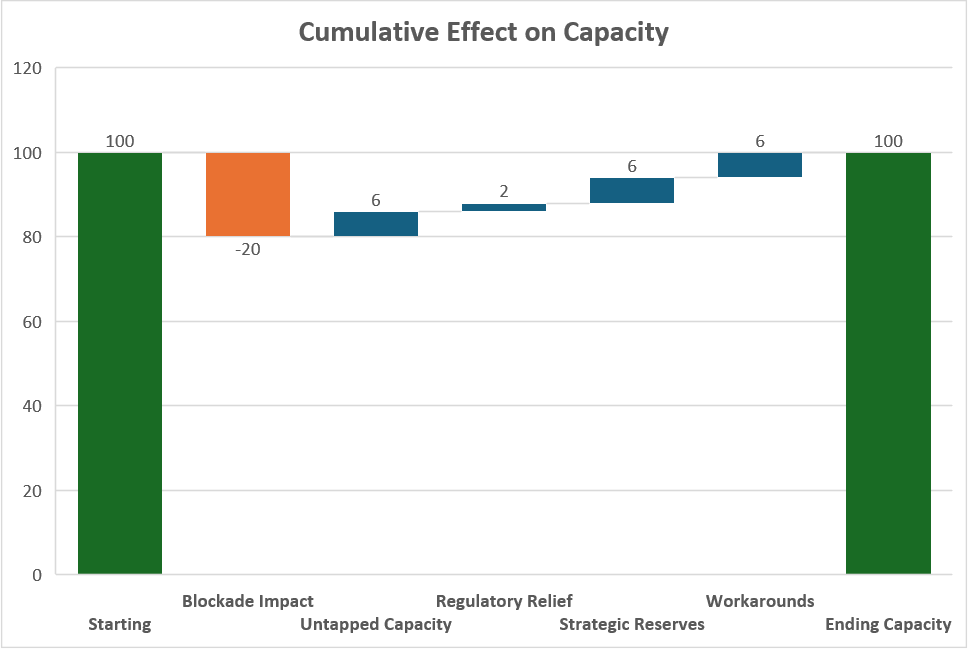
What is astonishing about this analysis is that it explains the lack of a dramatic price spike – because there was no severe supply constraint.
Is Demand Also Declining?
The shift to electric vehicles (EV) does have a real long-term impact. However, that impact is primarily one of holding demand steady instead of reducing consumption. First-time car buyers in China are opting for EVs instead of buying gasoline-powered cars.
Long-Term Implications
Perhaps the biggest takeaway is that we are likely entering an era of global oil and gas overproduction – especially when Iran and Russian re-enter the global economy. Oil prices are more likely to be going down than up over the next few years. In fact, on July 7th, Saudi Arabia cut the price of its Arab Light by $11, the first discount since 2020.
From an investor standpoint, the bottom line conclusion is that liquid gold might not make a very good investment over the next few years, and it would be wise to reduce exposure to oil and gas producers.