

Bloomberg recently covered AQR’s “tax alpha” strategy in a feature titled “A Tax Strategy for the Rich Built the World’s Largest Hedge Fund.” AQR is an excellent firm, and I respect both AQR’s strategy and execution. However, with both Fidelity and Schwab restricting access (The Ultrawealthy Tax Maneuver That’s Spooking Schwab and Fidelity) to this strategy, I thought I might share some insights.
The Strategy Really Is Deferring Gains
While the coverage emphasized tax-loss harvesting, this is fundamentally a tax-deferral strategy: losses offset gains, and winners are allowed to ride, compared with periodic rebalancing. Ultimately, the client will still need to pay taxes. AQR’s strategy differs from traditional loss harvesting by adding leverage.
AQR adds leverage to a client portfolio by shorting securities. Shorting means borrowing shares and selling them, with the obligation to buy them back later – profitably if the price falls, at a loss if it rises. The main costs are stock-borrow fees and the dividends or other distributions paid while you are short, which you generally must reimburse to the share lender. There are also trading costs, and hard-to-borrow names can carry punishing borrow rates.
The exhibit below shows the mechanics.
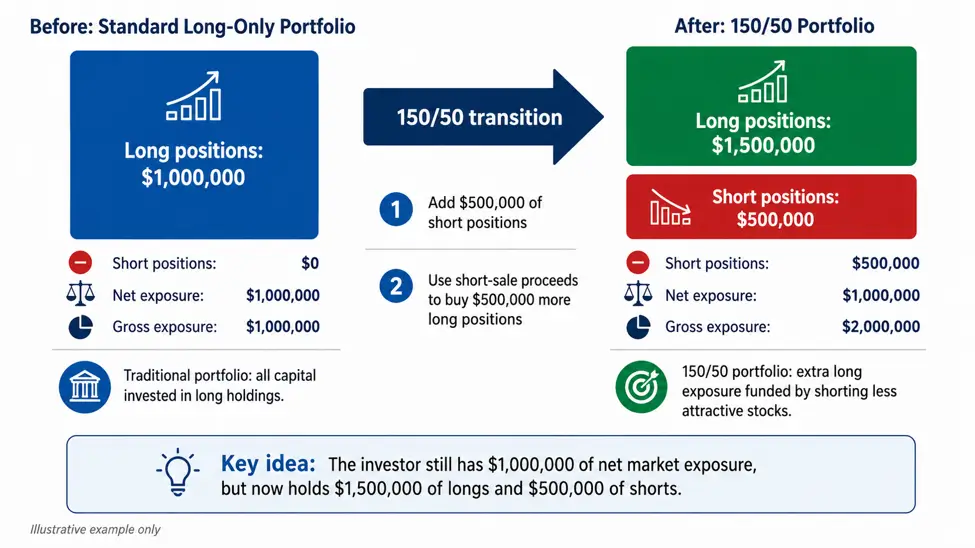
With a 150/50 portfolio (150% long, 50% short), the client has doubled gross exposure relative to a traditional long-only portfolio while holding net market exposure constant at 100%. AQR then harvests losses on both sides and realizes gains only selectively. The practical effect is to let the winners ride. The implications:
- More opportunities for gains and losses, because the portfolio is functionally twice as big.
- The loss engine runs in any market. In a falling market, the long book produces the losses. In a rising market, the short book produces them. That is the design: harvestable losses in either regime.
- The portfolio becomes progressively concentrated in low-basis winners, simply as a consequence of letting them ride. That creates two problems:
- Exiting those positions eventually triggers a significant tax consequence.
- The portfolio becomes less diversified over time, and investment decisions end up driven by tax consequences rather than by the best available opportunities.
Know the Tax Rules and Their Implications
A client pursuing this strategy needs to understand three Internal Revenue Code provisions.
Wash Sale Rule – IRC §1091
The wash-sale rule denies a current deduction for a loss on the sale of stock or securities if the taxpayer acquires, or enters into a contract or option to acquire, “substantially identical” stock or securities within 30 days before or 30 days after the loss sale – a 61-day window in total. The disallowed loss is not lost; it is added to the basis of the replacement shares. The rule also reaches short sales under §1091(e). This has two practical implications for loss harvesting.
First, the client cannot simply repurchase the same security the next day. They must stay out for 31 days and forgo whatever the stock does in the interim. This is why I rarely harvest on modest drops, particularly where nothing fundamental has changed. The client is likely to miss the rebound, and I would rather take the gain than manufacture the loss.
Second, the client frequently buys a “substitute” security and holds it through the window or longer. The problem is that in the real world there is rarely a perfect substitute. I do in-depth research on each holding, and I hold that position with conviction. There is no true stand-in for Apple, NVIDIA, or Alphabet. Selling them introduces tracking error that is likely to drag on returns over time.
Straddle Rules – IRC §1092
On paper, the elegant version of this trade would be to short the same names you hold long. There would be no tracking error, and whatever the market did, you would hold both a gain and a loss. The Code closes that door from two directions.
The straddle rules apply to offsetting positions – positions where holding one substantially reduces the risk of loss on the other. They need not be identical securities; a long position hedged by a correlated basket or sector short can qualify. Where they apply, a realized loss on one leg is deferred to the extent of unrecognized gain in the offsetting position.
Suppose a client realizes a $100,000 loss closing a short position and holds $80,000 of unrecognized gain in the offsetting long. The loss is currently allowable only to the extent it exceeds that unrecognized gain – roughly $20,000 in this simplified example. The remaining $80,000 is deferred, not permanently denied. Related rules under §263(g) can also require capitalizing, rather than currently deducting, interest and carrying charges on straddle positions.
Constructive Sales – IRC §1259
The constructive-sale rules prevent locking in an appreciated position without recognizing the gain. Suppose a client owns $1 million of Apple with a large embedded gain and shorts $1 million of Apple against it – the classic “short against the box.” The Code treats that as a sale of the appreciated position at fair market value, triggering immediate recognition. A narrow exception exists where the offsetting position is closed within 30 days after year-end and the long position is then held unhedged for 60 days, but it is a narrow path and requires deliberate planning.
Taken together, these three provisions explain why the strategy must short names different from the ones it holds long. That constraint is not a technicality. It drives the tracking error and residual risk discussed below.

The Biggest Risk: Leverage Plus Tracking Error
There is a market adage – usually credited to Keynes, though it appears to originate with the analyst A. Gary Shilling – that markets can remain irrational a lot longer than you can remain solvent. Over the years I have watched leveraged funds fail on exactly that principle. Long-Term Capital Management, run by Nobel laureates, required a Federal Reserve-organized recapitalization in 1998 when positions its models treated as low-risk moved against it simultaneously and its leverage left no room to wait.
The reality is that one day the portfolio will suffer a double whammy in which the long positions and the short positions both move against the client at the same time. The shorts are not the same securities as the longs – the tax rules above guarantee that – so there is no arithmetic that forces the two books to offset. In a correlated dislocation, they can and do move the wrong way together. Meanwhile the portfolio has been growing steadily more concentrated in its largest winners, so the damage from any single name is amplified.
Note also that the leverage is not the client’s to control. It is margin debt, callable and repriceable at the custodian’s discretion. That matters most precisely when the client can least afford it.
High-net-worth families care first about preserving wealth. An event like this can consume years of accumulated return.
Shorting Is a Losing Game
Short selling occasionally produces spectacular profits, but as a long-term strategy it is structurally stacked against the investor. Buying a stock caps the loss at 100% while leaving the upside theoretically unlimited. Short selling reverses that relationship: the maximum profit is 100%, and the potential loss is unlimited.
Short sellers also swim against the long-term tendency of equities to appreciate as earnings, productivity, and nominal economic activity grow. And being right is not enough – you must also be right about when the market will agree. Everyone loves the story of The Big Short; fewer people remember how many managers had the thesis right and the timing wrong, and did not survive to collect.
Short sellers face costs and risks that long investors generally do not. Shares must be borrowed, sometimes at substantial rates. The short seller must normally compensate the lender for dividends paid while the position is open. Collateral and margin must be maintained. The lender can recall the shares at an inconvenient moment. And rising prices can trigger a self-reinforcing short squeeze: as losses mount, brokers demand more collateral or short sellers voluntarily cut risk, forcing them to buy the stock back. Those purchases push the price higher, forcing still more covering. A company does not have to become fundamentally more valuable for a short seller to be destroyed – it only has to stay expensive, or get more expensive, for long enough.
Melvin Capital is the cautionary case in the consequences of a short squeeze. It began in 2021 with roughly $12.5 billion under management but was shuttered by May of 2022. Its short position in GameStop single-handedly caused the firm’s collapse.
Then there is crowding – which may accidentally lead to a short squeeze. More than $150 billion is now deployed across AQR and its competitors running factor-similar books, all needing the same borrow on the same names. That is a correlated short book at scale, and nobody’s backtest includes the crowd.
The Plumbing Is Already Under Strain
This is not a hypothetical concern. The custodians who finance these strategies have been pulling back. Fidelity paused new client assets going into long-short SMAs on its platform and subsequently raised financing costs. Schwab capped leverage on new enrollments and incoming transfers, raised account minimums, and limited how much of an advisor’s platform assets these strategies may represent.
Read that as a risk disclosure rather than as industry news. Two of the best-capitalized custodians in the country examined their own exposure to this trade and chose to shrink it, notwithstanding the revenue it generates. Institutions do not walk away from profitable lending for aesthetic reasons.
Regulators are watching as well. Treasury officials have publicly questioned whether some of these strategies produce results Congress ever intended. I would not assume the rules stay exactly where they are for the next twenty years – and this is a strategy whose payoff depends on a very long holding period.
The End Game Is Making Money – Not Capturing Losses
Over the long run, harvesting your losers and letting your winners ride produces a distorted portfolio that drifts steadily away from the allocation you would choose on the merits. Making tax avoidance the primary objective of a portfolio ultimately leads to underwhelming returns, with the client saddled with low-basis holdings whose day in the sun has long passed.
Keep in mind that most high-net-worth families already have a portfolio problem, and it is not a future one. It is the legacy low-basis holding they have owned for thirty years – concentrated, uncompensated, and untouchable because selling means writing an enormous check. This strategy does nothing about that position. Worse, it can compound the problem: the client now has a legacy concentrated position and a levered, high-turnover, low-basis, hard-to-exit managed account. Two illiquid tax prisons instead of one.
Final Thoughts: Use It as a Release Valve for Legacy Positions
There is a legitimate use case, and it is a narrow one. Harvested losses are genuinely valuable as a release valve for a legacy position. You run a program that generates loss capacity, then use that capacity to sell down the concentrated holding in tranches, offsetting the realized gain as you go. Done deliberately, that converts a permanent, uncompensated, single-name risk into a diversified portfolio at a controlled tax cost. That is a real service and it can be worth real money.
But notice how completely that reframes the mandate. The program now has a defined size – the loss capacity actually needed – a defined end date, and an emphasis on the minimum leverage required to get there rather than the maximum a custodian will extend. Success is measured in shares of the legacy position sold, not in dollars of losses harvested.
Ultimately, the question every investor should ask is not “how many losses did this generate?” The question is: after every cost, after every fee, and after adjusting for the risk taken and the optionality surrendered – did this beat the boring long-only alternative?
This commentary is provided for informational and educational purposes only and does not constitute investment, tax, or legal advice, or a recommendation to buy or sell any security or to adopt any investment strategy. Tax treatment depends on individual circumstances and may change; consult your own tax and legal advisors. References to specific firms, funds, or strategies are illustrative and are not recommendations. Figures cited are drawn from publicly available reporting and have not been independently verified. Past performance is not indicative of future results. Investing involves risk, including possible loss of principal; strategies employing leverage and short selling involve additional risks, including the potential for losses exceeding the amount invested.


